
Seeing the Invisible
How Caste Shattered My Illusions About Race, Merit, and the America I Thought I Knew

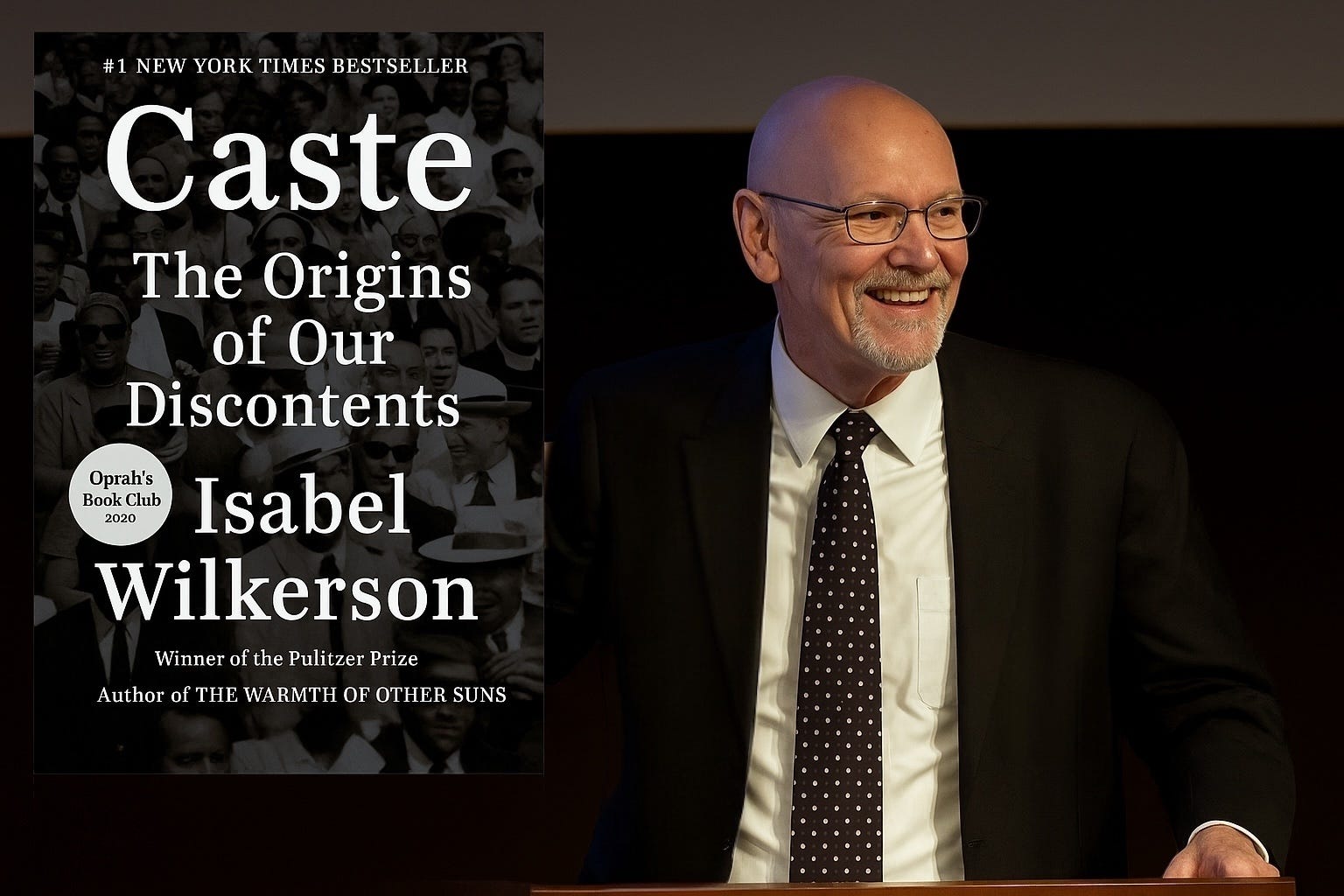
By Guest Contributing Writer Marc Friedman
Before reading Isabel Wilkerson’s Caste: The Origins of Our Discontents, I considered myself fairly aware of the injustices Black Americans have faced.
I understood discrimination existed, through segregation, bias, and unequal opportunity, but was unprepared for how deeply embedded those inequities were in the very structure of the society I grew up in, one that quietly but powerfully favored white men like me. Wilkerson’s book did more than inform me; it revealed the architecture of advantage that had been invisible to me for most of my life.
A New Lens on an Old Reality
Wilkerson reframes race in America not simply as a matter of prejudice or bias, but as a caste system, a rigid social hierarchy that, like those of India or Nazi Germany, defines human value and opportunity through inherited status.
This framework hit me hard. It forced me to recognize that the comfort and ease I often took for granted were not simply the fruits of my own effort but the products of a social order designed long before I was born, one that quietly placed people like me at the top of an unspoken ranking.
Her identification of the eight “pillars” of caste, ranging from dehumanization and purity codes to terror and heritability, helped me understand why the inequities I’d observed have proven so durable. What I once thought of as social or economic disparities, Wilkerson exposes as systemic and structural, sustained generation after generation through laws, culture, and even psychology.
Seeing Through New Eyes
What made Caste especially powerful for me was Wilkerson’s storytelling. Her blend of historical research and lived experience made abstract systems painfully personal.
When she recounts moments of casual but cutting prejudice — a flight attendant refusing to recognize her seat, or a contractor ignoring her presence — I was reminded of how often such slights go unseen by those of us not on the receiving end. It’s unsettling to realize how normalized such dynamics have been in the very world I’ve moved through unquestioningly.
The parallels she draws between American racial hierarchy, India’s caste system, and the racial codes of Nazi Germany were particularly eye-opening. The revelation that Nazi officials studied U.S. segregation laws as a model for their own racial policies made me confront the moral depth of America’s historical complicity. It reframed my understanding of “American exceptionalism” entirely.
A Moral Reckoning
What Wilkerson achieves in Caste is not just historical analysis but moral illumination. She compels readers, especially those of us who have benefited from the top rungs of the caste ladder, to look honestly at the forces that have shaped our lives.
I found myself asking difficult questions: How many of my assumptions about merit, success, or fairness have been conditioned by this unseen system? How often have I mistaken privilege for normalcy?
Wilkerson writes with the moral clarity of James Baldwin and the empathy of Toni Morrison. Her metaphor of caste as the bones of an old house particularly resonated with me. It captured the uncomfortable truth that even if we repaint the walls with good intentions, the structure itself remains flawed until we confront and repair its foundation.
From Awareness to Responsibility
Reading Caste was, for me, both humbling and liberating. Humbling because it exposed the depth of inequality I had never fully grasped; liberating because it offered a path forward—through awareness, empathy, and moral accountability. Wilkerson’s call to national introspection is, at its heart, a call to personal reflection. If America is an old house in need of repair, each of us must decide whether to be a bystander or a builder.
Caste: The Origins of Our Discontents is one of the most transformative books I’ve ever read. It opened my eyes to the invisible hierarchies that shape our society and to my own place within them. Wilkerson’s brilliance lies not just in her scholarship, but in her capacity to make readers, especially white Americans like me, see what has long gone unseen. It is a work of truth and grace, challenging and necessary, and it leaves me with a deeper understanding of both my country and my own moral responsibility within it.
Through our global Great Books, Great MasterMINDS online and in-person facilitated discussion communities, we gather in intimate circles, author interviews, and high-energy literary salons that spark wisdom, connection, and transformative dialogue.
In the meantime, there are no Substack paywalls here. Just an open invitation to join a movement rooted in community, conversation, and the power of great books to change how we see the world and each other.
If this journey enriches you, consider becoming a paid supporter or tipping us some coffeehouse love (dirty chai’s are my jam) so we can keep exploring together, page by page.
 | A guest post by
|
> It reframed my understanding of “American exceptionalism” entirely.
It's such a sliver of what you're writing about here (and I will pick up this book!) but I have begun living in fear of American Exceptionalism the phrase, often used like a flag and a tautology. On the lips of the far too thoughtless many, it seems to go further than apologizing for any specific details: It begs us to deny ourselves any details at all.
Thanks for writing this up!
I read this book when it was first published in 2020. I contracted all the Pollyanna history we were taught about race in the 50s. Every American should read this.